
What is Somatic Experiencing®?

It’s funny that something that’s central to my work still hasn’t made its way into a blog post. Maybe because it feels hard to write about without sounding overly clinical, too “woo,” or like I’m trying to sell something. But the truth is, Somatic Experiencing® (SE) has completely changed the way I understand and approach trauma, not just for clients but for myself too.
And since I’m not here to explain every last detail of anything, I figured this might be a good place to begin: a gentle, non-exhaustive, trauma-informed invitation into what SE is, how it works, and why it matters.

So… What Is It?
Somatic Experiencing is a body-based (aka "somatic") approach to healing trauma. It was developed by Dr. Peter Levine, who observed that wild animals experience life-threatening events all the time, but don’t develop trauma symptoms the way humans do. The idea is: trauma isn't in the event itself—it’s in the nervous system’s response to the event, especially when that response doesn’t get a chance to complete. SE is all about giving the body the time, space, and safety to do just that.
It’s not about reliving the trauma or even necessarily telling the whole story. It’s about tuning into the sensations of the body—what is called “interoception”—and gently supporting the nervous system in discharging stuck energy, completing stress responses, and returning to regulation. Sometimes this looks like subtle shifts in breath or posture. Other times it may involve tremors, heat, movement, or emotion that had to be suppressed in order to survive at the time.
Why Does This Matter?
Most of us walk around detached from our bodies to some extent. Maybe we had to. Maybe it was never safe to feel what we were feeling. But when we shut down sensation, we also lose access to things like joy, ease, and connection—not just pain.
SE helps us come back into relationship with our bodies at a pace that feels tolerable. It’s not about pushing through, forcing catharsis, or having a breakthrough on a timeline. It’s about creating enough safety that our systems can finally exhale, unfurl, and process what never got to be processed.
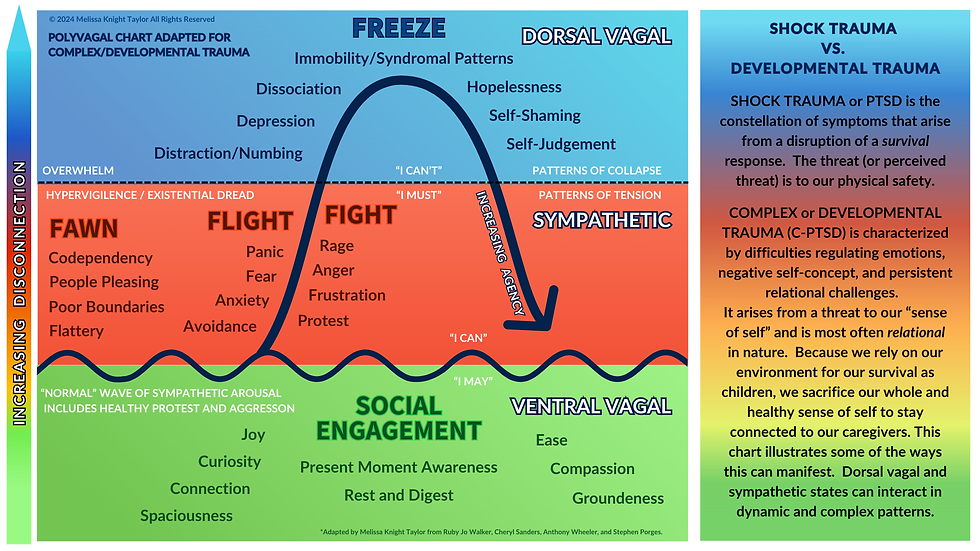
Trauma responses aren’t flaws in personality. They’re intelligent adaptations. They helped us survive. But when the danger is over and the body doesn’t catch up? That’s when symptoms stick around. Chronic anxiety. Disconnection. Exhaustion. Explosive anger or total numbness. Feeling like you’re always on high alert, or totally shut down. SE works with these states without pathologizing them—because they’re not disorders, they’re incomplete processes.
What Does a Session Look Like?
It might surprise you, but SE sessions are often really slow. In a world that rewards productivity and intensity, this can feel uncomfortable at first. But the slowness is intentional—it gives us the chance to notice what’s happening on a subtle level and stay inside our window of tolerance.
An SE session might include:
Tracking physical sensations in the body (heat, tightness, tingling, stillness, breath)
Orienting to safety in the here and now (using your senses to remind your body you're not in the past)
Pendulation (gently moving between discomfort and comfort so the system learns regulation)
Allowing stuck fight, flight, or freeze responses to begin to shift
Sometimes people expect dramatic emotional releases, but often it’s the quiet shifts that are the most powerful. A deeper breath. A relaxed jaw. A sense of “Oh… I’m okay right now.” These moments are gold.
Is This Just for People with “Big-T” Trauma?
Not at all. Trauma isn't only car accidents, war, or abuse. It's anything that overwhelms our capacity to cope and leaves a residue in the nervous system. That includes things like medical procedures, emotional neglect, chronic stress, identity-based harm, grief, bullying, and even the birth process.
SE can be especially helpful for people who’ve tried talk therapy and felt like it only went so far. Sometimes, what we need isn’t more insight—it’s more access to the parts of ourselves that got locked away when things were too much.
A Final Word
I don’t think any single approach is the be-all-end-all. SE isn’t a magic fix. But it is a respectful, body-honoring, trauma-aware path toward healing—and for many people (myself included), it’s the first time anything has felt like it actually works.
If you're curious, I encourage you to explore—slowly, gently, and with support. Healing isn't about perfection. It's about capacity, curiosity, and coming home to yourself in a way that doesn't feel like a threat.
Your body remembers everything. But it also remembers how to heal.


Comments